
Canine Adoption Readiness and Education Passport
Welcome to your C.A.R.E. Passport!
Why C.A.R.E.?
This is a new program being developed between Power Pups, Puppies for Parole, with dogs from Northeast Missouri Humane Society. Please take a moment to read through the website, e-book, and fill out the survey in the link below so that we can build the best program possible. Our mission is to bridge the gap between training in the shelter before adoption and the follow-up training in their new homes to prevent dogs from being relinquished back to the shelter. We want to give people the best lives with their dogs from the moment their dog comes home.
Congratulations on adopting your new dog! Your dog was part of a training group in the Missouri Department of Corrections Puppies for Parole and went through extra training to learn new skills to help them excel in your home. This is part of a pilot program we are running to help keep dogs in homes. As a trainer, I see rescue dogs struggling in their homes and owners who aren’t sure what to do to help. You are a vital part of our project, and we would love for you to read to learn about the project, what your dog was trained to do, and how you can continue working and build a relationship with your dog.
C.A.R.E. stands for Canine Adoption Readiness and Education. Your dogs were trained on ten foundation skills.
- Loose leash walking around distractions
- Settle on a mat
- Wait at an open doorway
- Recall into a collar grab
- Walk alongside another dog who is also being walked
- Send out and recall past distraction
- Target 2 feet and 4 feet on a platform and target nose to handler’s hand
- Accept a veterinary or grooming restraint
- Put nose in muzzle
- Settles quickly or doesn’t react to doorbells or knocking on a door
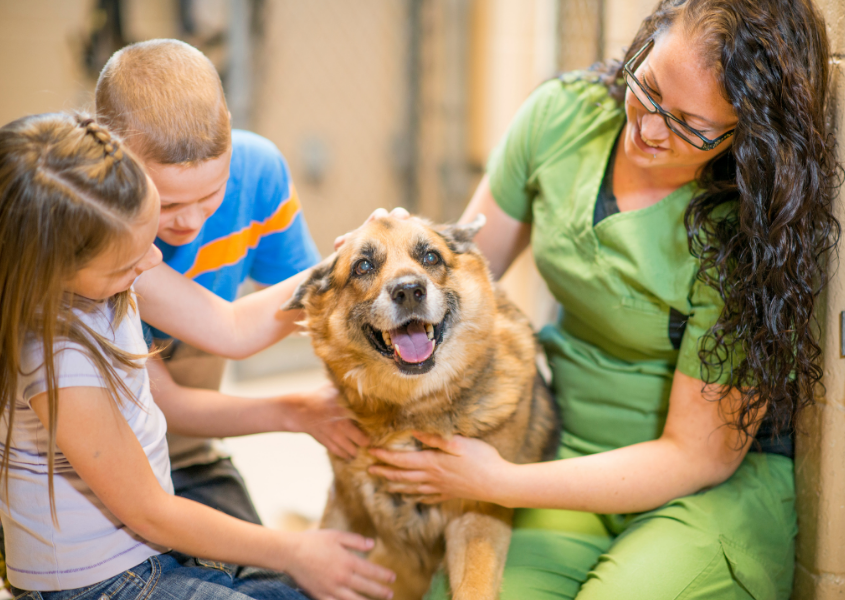
Training doesn’t stop when the dog goes home. This program is built to help fill that gap! When you download the e-book, you will get instructions for continuing working with your dog to teach them the skills that are beneficial to you in your home. You will find resources to build on your knowledge of dogs and you will learn how dogs learn. Our goal is to keep dogs in homes and give adopters tools to help them understand their dogs.
What to expect when you bring your dog home
Dogs can behave very differently when changing environments, schedules, and having new expectations put on them. Be patient, give them time to acclimate and build trust with you. This will help the transition period for everyone.
You can provide the dog a space to go that is theirs where no one else is allowed to bother them. This can be a crate or ex-pen or a room that they can go to.
- Give them potty breaks regularly, especially after sleeping, eating, play, and training.
- Keep clean, fresh water available at all times.
- Introduce other pets slowly.
- Provide different options for toys and treats to learn what your dog likes and doesn’t like.
- Provide quiet time for your dog to decompress.
- Take your dog on short, calm walks of their new neighborhood.
- Do not allow people to say hi to your dog unless your dog is calm and willing as a participant.
- Do not let children walk your dog unless an adult also has the leash in hand.
- Do not allow your dog to go up to unfamiliar dogs or people.
- Accidents and mistakes are likely to happen. Do not get upset or angry at the dog. They are still learning.
- Dog proof your home and remove any chewing or choking hazards.
- Prevention will go a long way to teaching your dog where boundaries are.
- Do not try to force play or a relationship. Allow the dog to open up to you.
- Provide enrichment like food toys or chew toys to allow your dog to decompress.
To help with the transition of your new dog into your home, we have created an e-book to guide you. You can read more about what 10 skills your dog worked on, why we decided on these specific exercises and how you can continue working with your dog on each skill so that skills transfer in your home.
You can fill out the survey below and receive a C.A.R.E. passport for your dog with yours and your dog’s new name (if it has been changed). Also, it will give us vital information about how this program is working and if it is something that should be continued for more dogs who are looking for homes.
Our Training Philosophy
Both the Puppies for Parole and Power Pups use force free training methods which are endorsed by the American Veterinary Society of Animal Behavior. These methods are based on evidence that positive reinforcement, classical conditioning, and humane relationship-building training and play sessions will increase behaviors that we want our dogs to perform. To read all of the AVSAB position statements on training and veterinary care, please click the link and scroll down to download them for free.